Tort Law 04 - The 4 Elements of Negligence
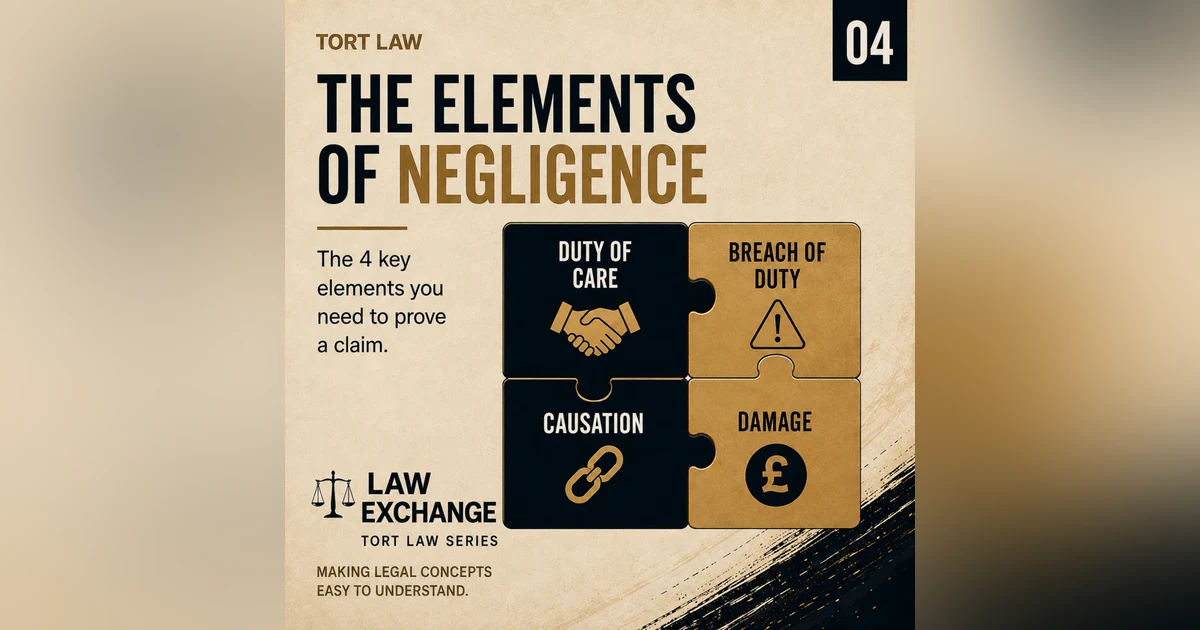
What are the four elements of a negligence claim? In this episode of Law Exchange, we break down duty of care, breach of duty, causation and damage, and explain how courts use this framework to decide whether someone should be legally responsible for harm.


The Four Elements of Negligence
In this episode of Law Exchange, we take the next step in our introduction to negligence by looking at the four elements a claimant generally needs to establish in a negligence claim.
We break down:
- Duty of care — did the defendant owe the claimant a legal duty to take reasonable care?
- Breach of duty — did the defendant fall below the required standard of care?
- Causation — did the breach actually cause the claimant's harm?
- Damage — did the claimant suffer legally recognised harm?
We explore the role of the reasonable person, the “but for” test, factual causation, remoteness, and why a careless act does not automatically make someone legally liable.
The episode also brings the four elements together through a simple road-accident example, showing how a negligence claim can be worked through step by step.
Most importantly, we look at why the four elements are not simply four boxes to tick. Each one asks a different legal question, helping courts draw the boundary between something going wrong and someone being legally responsible for what happened.
This episode provides a foundation for exploring the cases and more difficult questions that have shaped English negligence law.
Law Exchange — making legal concepts easy to understand.